
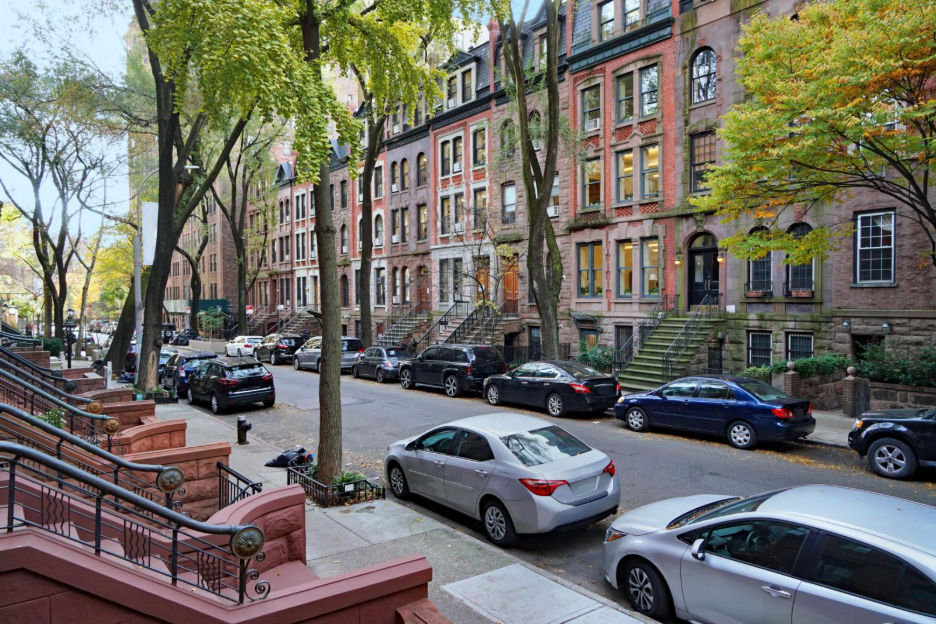
When people talk about climate change in New York City, they usually point to power plants, buildings, or mass transit. Parking almost never enters the conversation.
That’s a mistake.
In dense cities like NYC, how cars park matters nearly as much as how they move. The time drivers spend circling blocks looking for NYC parking, often dismissed as a minor inconvenience, quietly contributes to parking congestion, emissions, and neighborhood-level pollution.
Parking isn’t just a convenience issue. It’s an urban systems problem with real climate consequences.
Urban Parking Problems Are Climate Problems
Urban parking problems are often framed as personal frustrations: wasted time, stress, tickets, or inconvenience. But at a citywide scale, parking inefficiency creates a hidden layer of urban emissions that rarely shows up in climate conversations.
Every extra mile driven while searching for parking produces:
- Carbon dioxide (CO₂)
- Nitrogen oxides (NOₓ)
- Particulate matter that affects air quality
In NYC, where millions of short trips end with prolonged parking searches, these emissions accumulate quickly.
The issue isn’t just cars, it’s idle movement without destination. Cars that aren’t transporting people, but aren’t parked either.
That gray zone is where circling lives.
Circling and CO₂ Emissions in NYC
Multiple transportation studies have shown that a significant share of urban driving is caused by drivers searching for parking. In NYC, this effect is amplified by density, curb restrictions, and uneven parking distribution.
Car circling parking stats in NYC consistently show:
- Average circling times of 15–20 minutes per trip in dense areas
- Higher circling durations in Manhattan business districts
- Elevated emissions concentrated in residential-commercial transition zones
From a climate perspective, this matters because circling:
- Happens at low speeds (inefficient combustion)
- Occurs repeatedly on the same blocks
- Concentrates emissions where people live, walk, and bike
In other words, parking-related emissions don’t disperse evenly. They pile up locally.
Neighborhood Traffic Hotspots Created by Parking Behavior
NYC doesn’t experience parking-related emissions evenly across the city. Instead, they cluster into predictable hotspots tied directly to curb space availability and parking behavior.
Common high-emission zones include:
- Mixed-use neighborhoods with limited curb space
- Areas near hospitals, schools, and offices
- Streets with frequent loading and unloading activity
- Neighborhoods bordering commercial corridors
In these areas, cars repeatedly loop the same streets. Even when traffic volumes appear moderate, emissions stay high because vehicles are constantly stopping, starting, idling, and accelerating.
These are not highway emissions. They’re street-level emissions, directly affecting pedestrians, residents, and cyclists.
Urban parking problems, in this sense, become public health problems.
Why Traditional Parking “Solutions” Fall Short
Historically, cities have tried to solve parking problems in three ways:
- Build more garages
- Increase enforcement
- Adjust pricing
While each approach has value, none directly address circling.
More garages don’t eliminate searching—they often add traffic around entrances. Enforcement changes behavior but doesn’t reduce search time. Pricing influences demand, but without visibility, drivers still circle before deciding.
What’s missing is information.
Cities have spent decades regulating parking without making availability visible in real time. As a result, drivers behave inefficiently even when parking technically exists.
The Impact of Real-Time Parking Tools on Emissions
This is where modern parking technology enters the climate conversation.
A real-time parking app or data-informed street parking app reduces emissions by targeting the behavior that causes them: blind searching.
When drivers know where parking is likely to be available:
- They drive fewer unnecessary miles
- They reduce idle time
- They make faster parking decisions
- They stop looping the same streets
Even small reductions in circling time can produce measurable environmental benefits at scale.
This isn’t speculative. It mirrors what cities observed when GPS routing reduced congestion by minimizing unnecessary detours.
Parking visibility works the same way.
Community Data as Climate Technology
One of the most underappreciated climate tools isn’t infrastructure, it’s collective data.
Community-driven platforms like Snag demonstrate how shared parking insights can reduce inefficiency without building anything new. No concrete. No permits. No new lanes.
Just better coordination.
When drivers participate in shared parking awareness using tools like a parking app NYC drivers already rely on:
- Existing space is used more efficiently
- Demand distributes more evenly
- Fewer cars compete for the same curb
From a climate standpoint, this is powerful. It transforms parking from a zero-sum scramble into a shared system.
Snag approaches parking not as an isolated transaction, but as a network, one where individual actions produce collective benefits, including lower emissions.
Parking, Equity, and Environmental Impact
Parking inefficiency doesn’t affect all neighborhoods equally.
Lower-income and high-density neighborhoods often experience:
- Higher street-level pollution
- Greater traffic noise
- More frequent circling
These areas also tend to have fewer off-street parking options, pushing more drivers into curb competition.
Reducing circling isn’t just about convenience, it’s about reducing localized environmental burden. When parking becomes more predictable, emissions decrease where people live, not just where they commute.
This positions smarter parking tools and car parking solutions NYC as part of broader environmental equity efforts.
NYC’s Curb Space Is a Climate Lever
Curb space is one of the most valuable, and contested, resources in NYC. It supports parking, deliveries, ride-hailing, buses, dining, and bike infrastructure.
How that space is used directly shapes traffic patterns and emissions.
When curb access is opaque, drivers circle. When it’s predictable, drivers park and move on.
Cities often focus on electrification as the primary climate solution for transportation. That matters, but even electric vehicles consume energy while circling and still contribute to congestion.
Reducing unnecessary driving remains one of the fastest ways to lower emissions today.
How Snag Fits Into the Bigger Urban Picture
Snag wasn’t designed as a climate product, but its impact aligns with climate goals.
By helping drivers reduce circling and find parking faster through a NYC parking finder experience, Snag:
- Cuts unnecessary vehicle movement
- Lowers idle emissions
- Reduces localized congestion
- Improves street-level air quality
Importantly, it does this without requiring new infrastructure or behavior mandates. It works by aligning incentives, drivers want to park faster, and cities benefit when they do.
This makes community-driven parking data a rare example of climate-positive technology that people actually want to use.
Learning From Broader Emissions Research
According to emissions research from agencies like the EPA, short, inefficient trips contribute disproportionately to urban pollution. Stop-and-go traffic, idling, and low-speed driving are among the least efficient vehicle behaviors.
Circling for parking checks every one of those boxes.
Addressing it doesn’t require futuristic technology. It requires better coordination.
That’s why parking increasingly shows up in smart-city and climate-planning discussions, not as an afterthought, but as a lever.
Parking Is Part of the Climate Conversation
Urban parking problems are no longer just about convenience or enforcement. They sit at the intersection of mobility, equity, and climate impact.
In NYC, where millions of trips end in a parking search, reducing circling represents a tangible opportunity to cut emissions without new construction or regulation.
Smarter parking doesn’t just save time.
It saves fuel.
It reduces pollution.
And it reshapes how cities breathe.
Snag exists within this shift, not as a silver bullet, but as part of a growing recognition that how we park shapes how cities move, and how they pollute.
Frequently Asked Questions About Parking and Emissions
Does circling for parking increase pollution?
Yes. Circling increases CO₂ emissions, fuel consumption, and localized air pollution, especially in dense neighborhoods.
Can parking apps actually lower emissions?
When they reduce circling and idle time, yes. Even small reductions in unnecessary driving can have measurable environmental impact at scale.
Which NYC areas see the worst parking-related emissions?
Dense mixed-use neighborhoods, commercial corridors, and areas near transit hubs tend to experience the highest parking-related emissions.